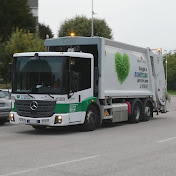
Farid T2 - Mercedes Econic - rear loader garbage truck
Italian RCVs
0:00 / 0:00
Farid T2 - Mercedes Econic - rear loader garbage truck
661 просмотр · 16 часов назад
Italian RCVs
85 подписчиков
661 просмотр · 16 часов назад
A really gorgeous (and eco-friendly) combo for today’s video: a Farid T2-27 rear loader, paired with a Mercedes Econic CNG, doing residual waste collection.
The Farid T2 body is well-known for its high-performance compaction system: thanks to the two pairs of rods, the packer travels up and down virtually frictionless, tranferring almost the entire force of the hydraulic cylinders directly to the waste. As a result, the compaction is much powerful than a standard rear loader with the packer plate sliding along guides.
This specific unit is equipped with lifting devices for almost any type of bins: double comb for wheelie bins, arms for 660-1100s, arms for 1700-2000s, lid opener for 1100s with dome lid, and even the additional arms for skips up to 7mc.
As advertised on the side walls, the CNG that powers this truck (as well as almost any other truck in the company’s fleet) is actually “biomethane”, obtained from food waste treated in a modern anareobic digestion plant (which I had the chance to visit, a couple of years ago!).
Finally, some words about the service: this truck is collecting non-recylable waste from commercial users and large block of flats in a municipality which enforces a PAYT (pay-as-you-throw) system.
The black bins are assigned to block of flats: the lid is locked and fitted with a steel drum of limited capacity, approx. 25 liters (in italian, these devices are called “calotte” or “limitatori volumetrici”). Residents can open only the steel drum with a personal smart card: by tracking the number of openings, the municipality knows the exact amount of waste generated by each resident and calculates the waste tax accordingly.
The green bins without the “calotta” are assigned to specific commercial users (shops, restaurants…), in this case the waste tax is calculated according to the number of emptyings of the bin, assumed to be full every time it is set out for collection.
