hisense WDQA8014EVJM - cotton 90
thelaundrycookie1200
0:00 / 0:00
hisense WDQA8014EVJM - cotton 90
3 729 просмотров · 2 месяца назад
thelaundrycookie1200
3,92 тыс. подписчиков
3 729 просмотров · 2 месяца назад
here is the first video of this hisense WDQA8014EVJM washer dryer which i was given as part of the house clearance of our elderly neighbour who unfortuately passed away in early 2025.
i would like to apologise in advance for the non-ideal filming setup for this machine. i tried, but i could not remove the heatshield on this machine. therefore i had to work around the rather dark heatshield, and as such, the lighting isn't great and i wasn't able to do any live temperature measuring as the thermometer would not have been visible. however, after running it in my own time, i am able to share that this cycle reaches ~80°C, similar to my other 2 hisenses. i will share this information for any cycles that i measured temperature of.
interestingly, this model was able to sense up by 10 minutes on this cycle. where my other two could only sense 15 minutes each way (except for eco 40-60). however, this model would still not increase or decrease by any more than 15 minutes (again, except for eco 40-60).
the main wash fills to drum rim level by default, which is decent although seems a little higher than my other two filled to by default. yes the porthole is wider, but the drum is slightly wider too so it ends up being around the same water level. this is visible in the really high energy usage due to the machine requiring more water than even my 10kg model needed, and that drum was bigger than this one! i was surprised by the reading as my other 2 hisenses have been rather efficient.
what i found really interesting is how much the water level increased by as the machine got hotter. this proves what i have mentioned in the past about certain fabrics becoming less absorbent with heat. as a result of this, the water level was too high and the machine did not add any additional water when it moved onto the cooldown period.
on the first intermediate spin, the machine actually sudslocked so bad that it cut out on the first burst. this doesn't happen too often for hisense. and actually my 9kg model never cut out from a sudslock once, no matter how bad it was (the 10kg only cut out like one time, too). anyway, it dealt with this by pausing and then restarting the spin. after it failed a second time, it performed a full anti-suds phase which consisted of an extended suds pause, a static drain, a semi-static emergency rinse (which didn't move after reaching the correct water level - really stupid as bulky items will then become really heavy on one side), then reattempting the spin. this proved successful.
after the emergency rinse and successfully reattempted interm, the machine performed the usual 3 rinses with the usual 950rpm interms. these rinses are semi-deep; around the same level as the 10kg WFQY.
it's nice that this machine didn't have the belt and bearing noises that the 9kg WFQP had, and also no jackhammer noise that the 10kg WFQY had. however, due to a loose screw, the front panel created some squeaking noises when unbalanced (i originally thought it was the door - it's not). i fixed this in later videos with tape as a temporary measure before tightening the screw after filming. but, at least we finally have a hisense where we can hear the motor properly.
this machine is more sensitive than the WFQP but less sensitive than the WFQY. this is fair enough as the drum is slightly wider than that of the WFQP, and we know how inconsistently sensitive the WFQY was.
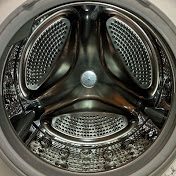
the drum is also much better designed on this compared to the other two hisenses. they all use the raindrop drum, but all have different variations of it. this one is the version with holes at the back, but improved by an increased amount of holes around the sides of the drum. this means the rinse and spin performances are better, but still semi-subpar unfortunately.
the final spin remains the same, with a 1 minute hold at 1320rpm. again, i wish it was a longer hold. but at least the 3s, 5s and 7s have improved final spins.
energy usage for this cycle was 3.129kWh.
this is the highest energy reading i have taken for a single cycle to this day.
00:00:00 - introduction and selecting cycle
00:04:20 - start and initial drain
00:04:53 - sensing
00:05:49 - saturation and main wash
02:37:24 - cooldown (no water added due to really high water level)
02:42:24 - first intermediate spin 950rpm (sudslock - reached 400rpm)
02:45:11 - sudslock cutout and brief suds pause
02:46:04 - failed reattempt (sudslock - reached 400rpm)
02:47:42 - sudslock cutout and extended suds pause
02:52:31 - semi-static very deep emergency rinse
02:59:17 - successful reattempt, up to 950rpm
03:07:38 - semi-deep first rinse
03:18:55 - drain and balancing for second intermediate spin
03:23:47 - successful attempt, up to 950rpm
03:30:20 - semi-deep second rinse
03:41:32 - third intermediate spin 950rpm
03:50:18 - semi-deep softener rinse
04:02:40 - final spin 1400rpm
04:14:52 - end, unloading and results
