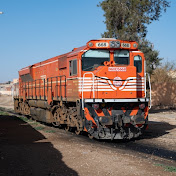
SNCFT: TRAIN 5/76 TRACTED BY Emd GT-562 Passing Rades Meliane Station
Trains Tunisie
0:00 / 0:00
SNCFT: TRAIN 5/76 TRACTED BY Emd GT-562 Passing Rades Meliane Station
947 просмотров · 6 лет назад
Trains Tunisie
5,67 тыс. подписчиков
947 просмотров · 6 лет назад
Harold L. Hamilton and Paul Turner founded the Electro-Motive Engineering Corporation in Cleveland, Ohio, in 1922, soon renaming it to Electro-Motive Company (EMC).[6][7] The company developed and marketed self-propelled railcars using General Electric's newly developed internal combustion-electric propulsion and control systems. Hamilton started his railroading career as a fireman, then locomotive engineer, on the Southern Pacific Railroad, then became a manager with the Florida East Coast Railway before he left railroading for a marketing position with the White Motor Company, an early manufacturer of trucks and buses, in Denver. Training and service agreements were part of White's marketing package that Hamilton would carry over to EMC. Aware of the needs of branch line services of railroads and the opportunities provided with GE's new internal combustion-electric propulsion and control technology, he quit his position with White and set up shop in a Chicago hotel with his partner and a designer to develop and market a new generation of self-propelled railcars. In 1923 EMC sold two gasoline-powered rail motor cars, one to the Chicago Great Western and the other to the Northern Pacific. EMC subcontracted the body construction to St. Louis Car Company, electrical components to General Electric, and the prime mover to the Winton Engine Company of Cleveland, Ohio. The motorcars were delivered in 1924 and worked well, fortunate for the fledgling company, because the sales were conditional on satisfactory performance. In 1925 EMC entered full-scale production, selling 27 railcars.
In 1930 General Motors (GM) was seeking to enter production of diesel engines and broaden their range of applications. They purchased the Winton Engine Company, who had in their product line a variety of stationary and marine diesel engines and spark-ignition engines for heavy vehicles. GM saw EMC's role in developing and marketing Winton-engined heavy vehicles as fitting their objectives and purchased the company shortly after the Winton acquisition, renaming it Electro-Motive Corporation (EMC). Supported by the GM Research Division headed by Charles F. Kettering, GM's Winton Engine Corporation focused on developing diesel engines with improved power-to-weight ratios and output flexibility suitable for mobile use.[8] Eugene W. Kettering, son of Charles Kettering, led Winton's side of the development project.
