Fantasie Choral No.2 in F sharp minor (1931).
Robert Fielding
0:00 / 0:00
Fantasie Choral No.2 in F sharp minor (1931).
79 просмотров · 5 мес. назад
Robert Fielding
7,72 тыс. подписчиков
79 просмотров · 5 мес. назад
Whitlock wrote two Fantasie Chorals which were published in 1936 by the Oxford University Press. They were written five years earlier during the summer of 1931 when he had been newly appointed at St. Stephen’s Church Bournemouth. They represent a significant part of the renaissance of British organ composition which had its beginnings in the works of Stanford, Parry, Harris and Elgar.
This second of the two Fantasie Chorals, in F sharp minor, appeared first and was dedicated to Edward Norman Greenwood, a friend and fellow student at the Royal College of Music. He was later assistant to George Thalben-Ball at the Temple Church, London. Greenwood asked Whitlock for his assistance in compiling the Christian Science Hymnal in 1931, Whitlock contributing four hymn tunes. While still in manuscript form, the piece was performed by Whitlock to the Organ Music Society in 1932 at Holy Trinity Church. Sloane Square, London.
On the 20 March, 1934, Norman Greenwood took part in a composite recital given by himself, Percy Whitlock and George Thalben-Ball at the Albert Hall, London. The concert was given for the Organ Music Society. Thalben-Ball played Howells' Sonata No.2 and Greenwood closed the programme with Charles Tournemire's Choral No.3.
In 1936, on publication, Whitlock's Fantasie Choral No.2 was broadcast live twice within four days: firstly, by Dom Gregory Murray from Downside Abbey on 25 September and by the composer from Broadcasting House, London on 28 September. Whitlock sent Murray a letter of thanks which said that he was ‘electrified by the long gap I had left before the final Full Organ chord’. Murray passed this on to Edna Whitlock forty years later in 1976.
Whitlock described the second Choral as ‘a set of free variations on a sixteen-bar tune of folk-song character. The first four bars of the introduction and the first six notes of the theme proper form the basis of the whole work, which roughly consists of four variations. The work is continuous, the variations being joined by material formed from the introduction’. (Riley ‘PWO&C’ p.60)
The Oxford University Press removed the two Fantasie Chorals from their print lists in the late 1950s as sales were dwindling. Whitlock’s widow, Edna, obtained the copyrights of them in 1980. In 1985, the Percy Whitlock Trust were able to fund a second edition, published by Basil Ramsey. A third edition was published in 1990 by Banks Music Publications in association with the Trust and includes several corrections and ‘Whitlock’s own timings as given in his recently discovered Repertoire Book’ (Malcolm Riley – Preface to the Third Edition).
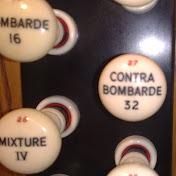
The organ used for this recording is the digitally recorded 2012 set for Hauptwerk of Hereford Cathedral's Willis organ by Lavender Audio, version 67 XL.
https://www.lavenderaudio.co.uk/organ...
Graham Barber’s 1988 Priory recording at Truro Cathedral is at:
• 2 Fantasie Chorals: No. 2 in F-Sharp Minor
Richard Pinel’s live recording on the organ in St George's Chapel, Windsor Castle on 1 Nov 2016.
• Richard Pinel plays Whitlock's Fantasie Ch...
The score I have used for this video is the 1936 OUP publication, now out of print.
The link to IMSLP and a free download of both Fantasie Chorals is:
https://imslp.org/index.php?title=2_F...
For Whitlock’s hymn tunes in The Christian Science Hymnal:
• Hymn Tunes by Percy Whitlock
Malcolm Riley's two books on Whitlock have been invaluable:
'Percy Whitlock - Organist and Composer' Thames Publishing, London 1998.
'The Percy Whitlock Companion' The Percy Whitlock Trust, Kent, UK, 2007.
