Weiss Sonata 38; Clive Titmuss, lute
Early Music Studio
0:00 / 0:00
Weiss Sonata 38; Clive Titmuss, lute
292 просмотра · 1 месяц назад
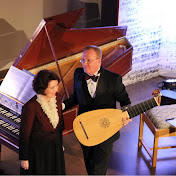
Early Music Studio
3,03 тыс. подписчиков
292 просмотра · 1 месяц назад
It was reported in a letter by Bach’s son Wilhelm Friedemann Bach that Sylvius Leopold Weiss and his colleague Kropfgans visited with J.S. Bach, and that it was a “very special day in the way of music”. Weiss composed approximately 600 pieces for the lute formally organized into “Suonatas”, actually an expanded suite form. His style is better described as Rococo than Baroque, because he absorbed influences from Italian and French string music while working in Rome before 1720. Weiss is noted for the quality and quantity of his work, even though only one of his pieces was published in his lifetime (by Telemann, in Der Gertreue Musikmeister, 1728-9). Weiss’ revival as a lutenist and composer took place with the advocacy of musicologist Hans Neeman, who wrote a biography, monographs about his work, and published six of his Dresden Suonatas, along with Suites by Esias Reusner, with parallel pitch notation and original tablature in the collection Das Erbe Deutscher Musik in 1939.
This autograph Sonata in C major (No. 38 of 42) Weiss is typical of his work from the later 1730/early 40s, found in the Dresden Manuscript (collected after c. 1720), with a combination of stylized French dance forms, and Italian keyboard forms (Corrente, Presto). There is a simple improvisational Prelude leading to a German-style Allemande in “stile antico”; this is followed by a perpetual motion Corrente; a French-style Bouree; a repeated-note Sarabande which reminds us of the tolling of a bell; an Italian concerto-style Presto; and concluding the group, a deceptively simple Menuet with intricate ornamentation and counterpoint. As a whole, this work is a mature form, intended to be performed as a group, wheras Weiss’ earlier procedure of construction grouped disparate pieces according to key in the 17th C. manner (found in the British Museum MS, ADD 30387, collected before 1720). The bass lines and harmonic progressions stem from motivic ideas found throughout the group, effectively unifying the content into a single statement. Notable too, is Weiss’ mastery of the lute’s dynamic resources, his eloquent melodic gift and idiomatic transparency of texture.
Weiss (1686 or 87?–1750) is the most celebrated lutenist of the 18th century and one of the most prolific composers in the history of the instrument. He was employed at several German-speaking courts, including Breslau, Düsseldorf, and Rome (where he served Prince Alexander Sobieski from 1708 to 1714). In 1718, was appointed in Dresden as a court musician for Elector Augustus the Strong, (father of Frederick the Great) remaining there until his death and eventually becoming the one of the highest-paid instrumentalists at the court. Weiss was renowned for his technical mastery, his improvisational skills, and pre-eminently as a composer of masterfully written pieces for the lute. His works reside in the two best-known collections (British Museum MS and Dresden MS), and his music was frequently hand-copied and disseminated by other lutenists/teachers in the German-speaking world.
Though Weiss is well-known today, he is the first among equals. There was much activity in general in the lute world of the early to mid-18th Century in German-speaking areas, even as the lute was in decline in France, England and other regions of Europe. There are many great composers whose work has been similarly revived: Logy, Lauffensteiner, Weichenberger, Hinterleitner--all active in Vienna. While Bach was Kantor at the Thomasschule in Leipzig, two of his students, Straube (two Sonatas published in Leipzig; later he moved to London) and Krebs (two MS concertos) played and composed excellent lute music. There were also published contemporaries: Kellner, Baron, Conradi, Falckenhagen--and their fine music survives.
It was my intention to make some of the lute’s mid-18th C. repertoire known in this expanded context through recorded performances of works by lutenist-composers contemporary with Bach and Weiss, so I recorded an album of music on several styles of lutes from this fascinating world, entitled “The Twilight of the Lute: German Music of the 1740s”. Listen here on YouTube: • Prelude, Fugue & Allegro, BWV 998: I. Prelude
Audio is by Chaianne Ellis at SoulTech Audio, video is by Clive Titmuss and video editing is by Susan Adams. The 13-course lute is by Robert Lundberg 1978, after Tieffenbruecker 1603/Edlinger 1740?. Please leave us a comment because we love to hear from you!
You might also enjoy;
Bach Trio Sonata • Bach Trio Sonata I, BWV 525 - Clive Titmus...
Soler Fandango • Soler Fandango; Clive Titmuss and Susan Ad...
Bach Prelude, Fugue & Allegro • Bach; Prelude, Fugue & Allegro BWV 998 - C...
Capirola pieces • Pieces by Capirola, Part 1 - Clive Titmuss...
0:00 - Prelude
0:54 - Allemande
4:32 - Courante
7:26 - Bourée
11:04 - Sarabande
15:10 - Presto
19:54 - Menuet
