How Far Away Is the Moon, Really?
Earthrise Stories
0:00 / 0:00
How Far Away Is the Moon, Really?
139 просмотров · 8 дн. назад
Earthrise Stories
19 подписчиков
139 просмотров · 8 дн. назад
About 30 Earths fit in the gap between us and the Moon: roughly 239,000 miles on average. Driving nonstop at 65 miles an hour would take about five months. In this video we measure the real distance with everyday American yardsticks, line up the other seven planets in the gap, visit the mirrors the Apollo astronauts left behind, and find out why the Moon is slowly drifting away, roughly as fast as your fingernails grow.
Chapters
0:00 Thirty Earths between us and the Moon
1:00 Your brain can't do space
1:56 Road trip to the Moon
3:43 The planets almost fit
4:49 Twelve people have been there
6:35 The Moon is leaving
8:34 Look up tonight
Sources
NASA Space Place, "How Far Away Is the Moon?" (spaceplace.nasa.gov/moon-distance)
NASA NSSDCA, Moon Fact Sheet and Planetary Fact Sheet (nssdc.gsfc.nasa.gov/planetary/factsheet)
NASA JPL, "The Apollo Experiment That Keeps on Giving" (jpl.nasa.gov/news/the-apollo-experiment-that-keeps-on-giving)
T. Murphy, UC San Diego, Lunar Ranging Basics (tmurphy.physics.ucsd.edu/apollo); T. Murphy et al., "APOLLO: the Apache Point Observatory Lunar Laser-ranging Operation" (arXiv:0710.0890) and "Laser Ranging to the Lost Lunokhod 1 Reflector" (arXiv:1009.5720)
NASA, Apollo 11 Mission Overview; Apollo 13 Mission Details; "The 12 Moonwalkers" (science.nasa.gov/moon/moon-walkers)
NASA, Saturn V facts (nasa.gov); NASA, "15 Years Ago: New Horizons Launched to Pluto and Beyond"
NASA, "NASA's Artemis II Crew Eclipses Record for Farthest Human Spaceflight" (April 6, 2026) and "NASA Welcomes Record-Setting Artemis II Moonfarers Back to Earth" (April 10, 2026)
Fingernail growth: Yaemsiri et al., J Eur Acad Dermatol Venereol 24(4), 2010 (about 3.5 mm per month; "roughly" in the video)
Our own calculations from these figures: Earth-and-Moon-in-a-textbook scale (Earth 1 inch wide, Moon about 2.5 feet away), the car, jet and walking times, the planet line-up (planet diameters from the NASA Planetary Fact Sheet), and the 85 road trips from New York to Los Angeles (about 2,790 road miles).
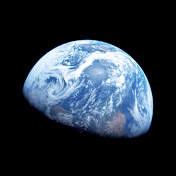
Footage and images (public domain, NASA): Apollo 8 "Earthrise" (1968), Apollo 11, 13, 14, 17 photographs and the Apollo 11 television film, Saturn V and Apollo 11 launch film (NASA/KSC/MSFC), Galileo and DSCOVR/EPIC images of Earth and Moon, Lunar Reconnaissance Orbiter images and NASA Scientific Visualization Studio animations, Artemis II photographs, launch and splashdown film (2026), NASA Goddard laser footage. The 3D Saturn V reconstruction uses the NASA 3D Resources model (public domain).
Maps, charts and all explainer sketches are our own work (map data: Natural Earth). The thumbnail backgrounds are AI-generated illustrations. Narration uses an AI voice; the script was written with AI assistance and checked against the sources above.
Impressum: [Link einfügen]
#moon #space #nasa #apollo #earthrise
